
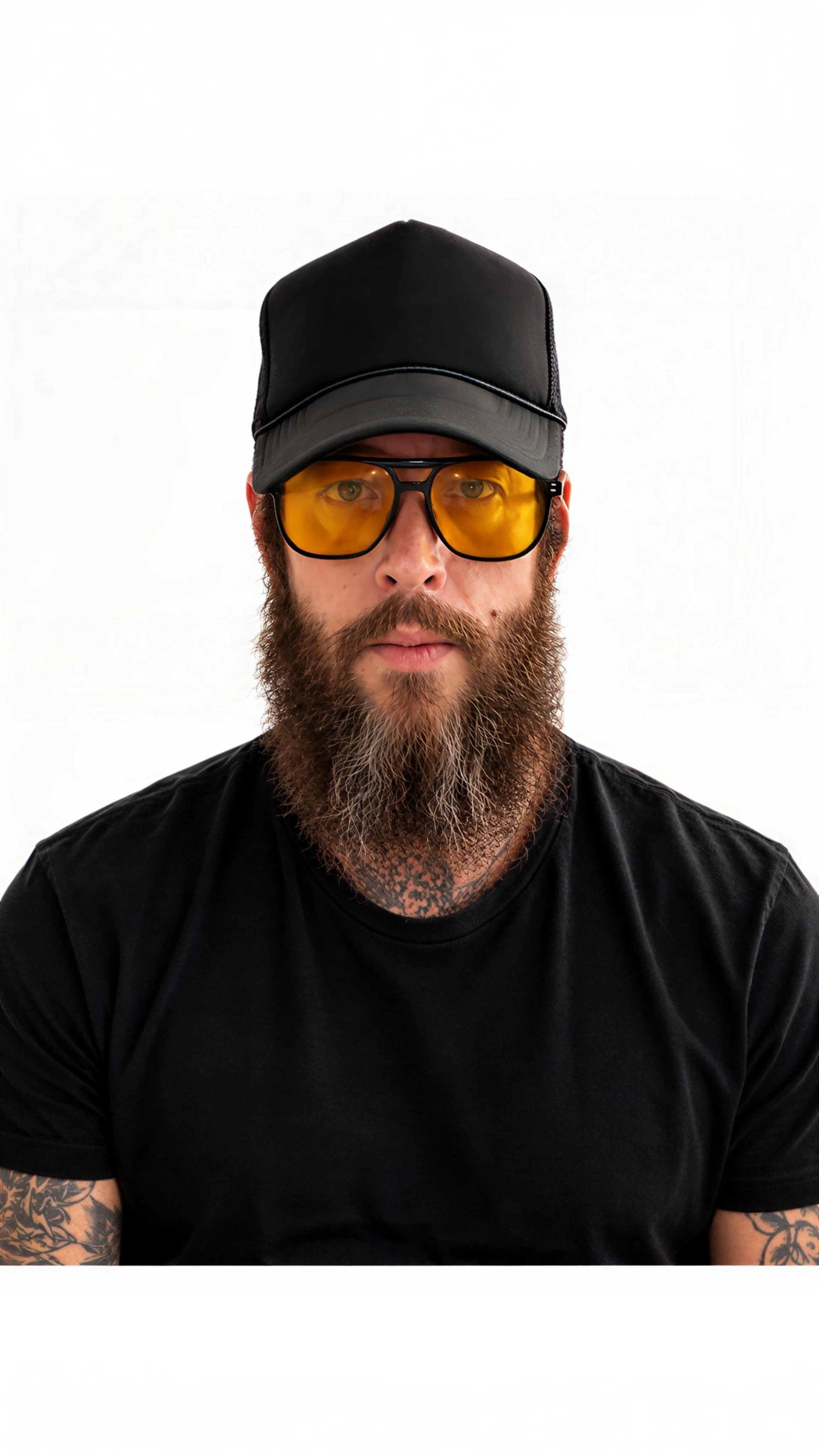
Seb Webber is a cultural engineer whose story begins in the mailroom of XL Recordings, though most people now know him for his work in artificial intelligence and entertainment. He is an executive producer and leadership consultant based in Los Angeles. Over the past several years he has worked out how an AI-native studio actually operates: the pipelines, the creative standards and the ethical rules that let generative technology meet the expectations of the world's biggest brands and storytellers.
He has often been the first to do something. He led the first use of generative AI on network television, working with Fox Entertainment on The Masked Singer. Since then he has delivered more than a hundred pieces of broadcast AI content, drawn more than a billion views across social platforms in eighteen months, and built a network of more than three hundred specialist AI artists. Along the way he has worked with Netflix, Disney, Fox, Mattel, AMBUSH, Apple Music, Atlantic Records, Univision, Coldplay, Muse, J Balvin, the U.S. Department of Defense, Warner Music Group, Johnson & Johnson, Neutrogena, The North Face, M.I.A., Adele, Universal Music Group and Zynn.
Much of that work involved more than new technology. When Netflix, Mattel and the estates of famous actors and musicians brought him in, the job also meant handling likeness, legacy and intellectual property with great care. Working with that kind of material made Webber a trusted voice on AI ethics and IP security. He came to believe that rights holders, talent and audiences all need to be able to trust what is being made and how.
He also made his name in workflow design. Webber built hybrid pipelines that combine generative tools with traditional filmmaking craft, so teams could work faster without losing quality or control. That approach made him one of the most sought-after executive producers for AI-native studios. He has led studio tests for major Hollywood studios and well-known directors to show what AI-assisted production can achieve at the highest level. Today he also advises Fortune 500 companies on AI strategy and hybrid production, and the Los Angeles Times, CBS and Variety have covered him as an innovator in the field.
From this work came MONOROMA, the studio Webber co-founded with the technologist Tom Graham. It is based in Culver City and has a presence in Mexico City, London and Lisbon. MONOROMA is a full-service AI production studio and R&D lab devoted to hybrid productions and fully generative storytelling. Its method, which it calls grey box or grey stage production, pairs real performance with generated worlds. Using its own tools, the studio produces broadcast-quality images that match the standard of a conventional pipeline in a fraction of the time and at a fraction of the cost. Its network of more than three hundred AI artists grows or shrinks to fit each project, so the studio can work at scale while human craft still controls the quality.
One of its best-known projects is Dream Protocol: ON, a Barbie x YOON film MONOROMA wrote, produced and directed for Mattel and AMBUSH. It is ninety seconds long, entirely AI-generated and set in a futuristic Tokyo, and it follows a "machine Barbie" as she wakes up for the first time. The film went on to earn nominations and wins at creative awards around the world.
MONOROMA takes a project from first idea to final master under one roof, covering writing, direction, production, rights and finishing. A client briefs the studio once and gets back work that is ready to air. Some of that work blends AI generation shot by shot with live-action footage, visual effects and editing. Some of it is fully AI-native film, series or commercial work. The studio also makes original animation in many styles and can keep a character consistent across hundreds of episodes. It builds worlds and sets that would be too expensive to construct for real, and it creates the style guides and story universes that let a franchise grow through both official content and fan creation. It can also make several versions of the same piece, each with a different hook, cut, character or ending, so audience response can guide the final creative choice.
The studio's signature process is called MONOROMA: ONE. Actors perform for real on a neutral grey stage under controlled light, and the world is generated around them: locations, crowds, weather and a scale no budget could build. The environment is composed live on set, so the director sees the finished frame while the crew is still working. Afterward, the performance and the generated world are matched frame by frame, then graded and finished in-house. A small crew from traditional film, with cinematographers working alongside AI technical directors, delivers productions in about half the usual time with full creative control. For major studios, MONOROMA also works as an outside research lab. It tests new formats and new ideas quickly, then hands the successful ones back to the studio to produce and distribute.
The partnership combines Webber's production and creative leadership with Tom Graham's experience as one of the most influential technologists in generative AI. Graham co-founded and runs Metaphysic, the hyperreal AI company that TIME named among its 100 most influential companies of 2023. Metaphysic became famous for the viral DeepTomCruise videos and for bringing Elvis Presley back to the stage on America's Got Talent. It also worked with CAA on generative AI tools and with Miramax on hyperreal performances for the film Here, and it was later acquired by DNEG. Before Metaphysic, Graham co-founded Heavy.ai at MIT, a data analytics company backed by NVIDIA, Google, NEA and In-Q-Tel. He also founded Codec.ai, a content analytics platform used by Red Bull, Unilever and L'Oréal. He is a former capital markets attorney and visiting scholar at Harvard Law School, and he speaks widely on AI ethics, digital likeness and individual rights. Those principles shape how MONOROMA works.
That focus on ethics helps explain why Netflix, Mattel, Fox and the estates of famous performers trust Webber with some of the most valuable and sensitive intellectual property in entertainment. He treats a client's characters, faces and brand assets with the same secrecy as an unreleased film. For the most sensitive projects, the work runs on models hosted locally on secured machines, so nothing leaves a controlled environment or reaches a public cloud. When cloud tools are used, they are approved enterprise versions with contractual protections, including a promise not to train on client data, and clients' legal teams review the data handling before production begins. Rights, digital replica agreements and likeness permissions are managed from start to finish, and talent and estate approvals are in place before anything is generated. The result is a clear record of what was made, how, and with whose permission. Artists work under NDA, access to assets is tightly controlled, and delivery is secure, so sensitive material is seen only by the people who need it. That mix of creative ambition and careful safety is why rights holders who would never give their IP to an ordinary AI vendor bring it to him.
His sense of where culture and technology are heading came from two decades in the music industry. At XL Recordings, under founder Richard Russell, Webber rose from the mailroom to Product Manager and then to Director of A&R. He worked with Adele, Radiohead, Thom Yorke, The White Stripes, M.I.A., Basement Jaxx and Peaches, and he did A&R work on Adele's landmark albums 19 and 21 and on M.I.A.'s Kala. Outside the label, he also contributed to Leona Lewis's I Am and Steve Angello's Wild Youth.
While building his label career, he also started companies. He co-founded CrowdSurge, an artist-controlled ticketing platform that competed directly with Ticketmaster and counted Coldplay, Foo Fighters and Paul McCartney among its early clients. After the company raised outside investment, Webber sold his stake to Warner Music Group owner Len Blavatnik at a thirty million dollar valuation. CrowdSurge was later folded into Songkick.
From there he became Creative Director of TIDAL, Jay-Z's artist-owned streaming service, and helped shape its identity in the early days of streaming. He worked one on one with Jay-Z to roll out the platform's global content strategy, development and production.
He went on to found the electronic label FMLY with Universal Music. He also executive produced Giorgio Moroder's comeback album Déjà Vu, which featured Britney Spears, Kylie Minogue, Sia, Charli XCX and Kelis. Two of its songs reached number one on Billboard's dance chart: "Right Here, Right Now" with Kylie Minogue and the title track with Sia. Over the years he has worked with Tyler, The Creator, The Prodigy, Rusko, N.A.S.A., Ferry Corsten, Markus Schulz, Lionel Richie, At the Drive-In, DJ Fresh and Brendan Canning of Broken Social Scene. He has executive produced music videos for Muse, J Balvin, Rosalía and Ozuna, John Legend, Jack White, Lauren Jauregui, Kevin Gates, Night Moves and Elkin. His creative work has since included collaborations with Coldplay, J Balvin and Jay-Z, as well as projects for the U.S. Department of Defense.
Taken together, that career in A&R, artist-led ticketing, streaming, label building and executive production is the foundation Webber now brings to artificial intelligence. Today he leads studios that use the technology to tell better stories while protecting the artists, estates and intellectual property behind them.
Seb Webber lives in Los Angeles. He can be reached at seb@monoroma.studio, or most quickly on WhatsApp at +1 (424) 479-8820. More about him can be found on Wikipedia and IMDb.